

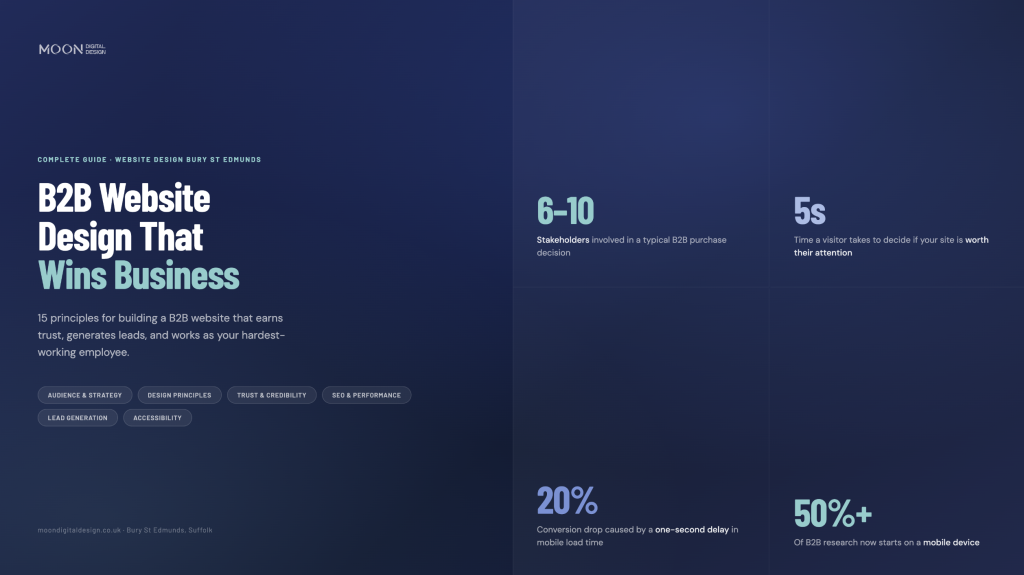
Why Your B2B Website Is Your Hardest-Working Employee
For a business-to-business company in Bury St Edmunds, the stakes around your website are higher than ever. Unlike consumer brands that might rely on impulse and emotion, B2B buyers do their homework. They compare vendors, read case studies, download specifications, share links with colleagues, and only reach out when they have already built a shortlist. By the time a prospect fills in your enquiry form, they have often already decided whether you are a credible partner, and that decision was made on your website.
This is why investing in quality website design matters so much. Whether you are a manufacturing firm in Suffolk Business Park, a professional services practice on Angel Hill, or a SaaS company serving clients across East Anglia, your website is the single most important sales and marketing asset you own. It works around the clock, speaks to every stakeholder in the buying committee, and either builds confidence or quietly erodes it.
This guide walks through the key aspects of B2B website design, with practical examples drawn from the kind of work we see every day with businesses across Bury St Edmunds, Ipswich, Cambridge, and the wider region. Whether you are planning a full redesign or refining an existing site, the principles below will help you make better decisions and get a stronger return on your investment.
Understanding Your B2B Audience Before You Design Anything
The most expensive mistake in B2B web design is jumping to visuals before you understand who you are designing for. A beautiful site that fails to speak to the right people will always underperform a plain site that nails its audience.
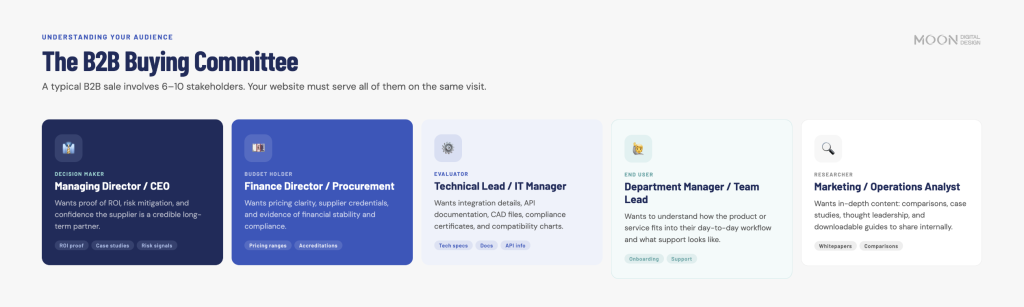
Mapping the Buying Committee
B2B purchases rarely involve a single decision-maker. A typical B2B sale involves six to ten stakeholders, each with different priorities. Your website needs to serve technical evaluators, financial approvers, end users, and executive sponsors, often all on the same visit. A procurement manager wants pricing clarity and supplier credentials. A technical lead wants integration details and API documentation. A managing director wants proof of ROI and risk mitigation.
Researching Intent, Not Just Demographics
Job titles tell you surprisingly little. What matters is intent: what is the visitor trying to accomplish? Are they in the awareness stage, trying to understand if they even have a problem? Are they comparing vendors? Are they checking whether an existing supplier is still the right fit? Effective website design responds to each of these intents with the right content in the right place.
The Core Principles of Effective B2B Website Design
Great B2B websites share a handful of fundamental characteristics, regardless of industry or budget.
Clarity Over Cleverness
Your homepage should answer three questions within five seconds: what do you do, who do you do it for, and why should I care? Too many B2B sites lead with vague slogans or industry jargon that leaves visitors hunting for basic information. If a first-time visitor cannot explain your value proposition after a short scroll, the design has failed.
Credibility Built Into Every Pixel
In B2B, trust is the currency. Credibility is communicated through visual polish, consistent typography, accurate spelling and grammar, sensible use of whitespace, and tasteful photography. It is also communicated through the absence of amateurish touches: stock photos that scream “stock photo”, mismatched icon sets, cluttered layouts, and outdated copyright dates in the footer.
Designed for Skim-Readers
B2B buyers skim before they commit to reading. Use short paragraphs, descriptive subheadings, bulleted summaries, and pull quotes to help them extract value quickly. If a visitor can understand the gist of a page by reading only the headings, you are doing it right.
Homepage Design: Making the First Impression Count
The homepage is your handshake. For businesses investing in professional website design in Bury St Edmunds, this page deserves the greatest design attention.
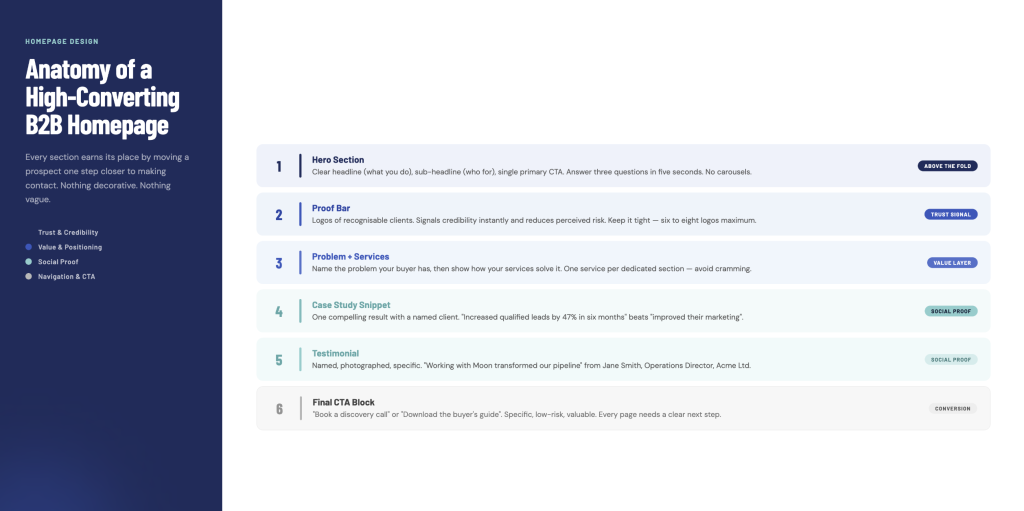
The Above-the-Fold Hierarchy
Your hero section should contain a clear headline stating what you do, a supporting subheadline clarifying who it is for, and a single primary call to action. Resist the urge to cram in carousels, multiple CTAs, or lengthy paragraphs. A carousel dilutes every message it contains; research consistently shows click-through rates collapse after the first slide.
Supporting Sections That Move Prospects Forward
Below the fold, build a logical narrative: the problem you solve, the services or products you offer, evidence that you deliver, and a clear next step. A useful structure for Suffolk-based B2B firms is: headline, proof bar (client logos), service overview, case study snippet, testimonial, and a final CTA block.
Example: A Local Engineering Firm
A manufacturing client serving clients across East Anglia rebuilt their homepage around a single question: “Looking for a CNC partner who can hit tight tolerances without blowing deadlines?” That one sentence, paired with a photograph of their shop floor and a short list of accreditations, tripled enquiry rates within three months. Clarity beat cleverness.
Service and Product Pages That Convert
If the homepage is your handshake, service pages are your pitch.
Structure Each Page Around a Single Offering
Avoid the temptation to lump multiple services onto one page. Each core offering deserves its own dedicated URL, written to match the specific questions buyers ask about that service. This also gives you stronger SEO footing when someone searches for “website design Bury St Edmunds” versus “SEO services Suffolk”, two distinct intents that deserve two distinct pages.
The Ideal Service Page Anatomy
A high-performing service page typically includes: a clear headline, a problem statement the reader identifies with, a description of your approach, deliverables and outcomes, proof (case studies, testimonials, logos), FAQs, and a dedicated CTA. Pricing transparency, even in broad ranges, dramatically improves qualification.
Product Pages for Technical Buyers
If you sell physical or technical products, downloadable data sheets, CAD files, compliance certificates, and compatibility charts are non-negotiable. Technical evaluators want to verify your claims without having to speak to a salesperson.
Navigation and Information Architecture
Even beautifully designed websites fail if visitors cannot find what they need.
Keep the Main Menu Short
Aim for five to seven items in your primary navigation. Common B2B patterns include: Services, Industries, About, Case Studies, Insights, and Contact. Dropdowns should reveal no more than six or seven sub-items to avoid overwhelming the visitor.
Use Plain Language, Not Internal Jargon
Label menu items with words your customers use, not your internal department names. “Professional Services” means something to a consultancy, but “Implementation Support” may be clearer to the buyer.
Design Footer Navigation Strategically
Your footer is prime real estate for secondary navigation, contact details, key service links, and local SEO signals. For a Bury St Edmunds business, the footer is an excellent place to reinforce your address, postcode, and service area, which reassures local prospects and supports local search visibility.
Trust Signals and Social Proof
B2B buyers are risk-averse. Trust signals reduce perceived risk and accelerate the sales cycle.
The Most Effective Trust Elements
Logos of recognisable clients, named testimonials with photographs, detailed case studies with measurable outcomes, industry accreditations, certifications (ISO 9001, Cyber Essentials, ICO registration), awards, and years in business all contribute. The key is specificity: “Increased qualified leads by 47% over six months” is more persuasive than “improved our results”.
Case Studies as Sales Tools
A well-written case study follows a clear arc: the client’s challenge, the approach you took, what you delivered, and the measurable outcome. Include quotes from the client where possible, and always name the company unless a confidentiality agreement prevents it. For professional services firms, three to five strong case studies can carry an entire website.
Reviews and Third-Party Validation
Google Business Profile reviews, Trustpilot ratings, and industry directories add external credibility. For local B2B firms, prominent Google reviews are particularly powerful because they also support rankings for “website design Bury St Edmunds” and similar geographic searches.
Lead Generation and Conversion Optimisation
A beautiful website that does not generate enquiries is an expensive brochure.
Calls to Action That Actually Work
Every page should have a clear primary CTA and, where appropriate, a secondary CTA for visitors who are not yet ready to buy. “Book a discovery call” is better than “Contact us”. “Download the buyer’s guide” is better than “Learn more”. Specificity and value are what earn the click.
Forms That Respect the Visitor
Short forms convert better than long ones. Ask for only what you genuinely need: name, email, company, and perhaps a message. Every additional field reduces completion rates. If you need richer qualification, use progressive profiling or a short booking flow rather than a wall of fields.
Lead Magnets for the Top of the Funnel
Not every visitor is ready to buy today. Offer a guide, checklist, calculator, or template that solves a specific problem for your ideal customer. This captures interest from buyers who are still researching and gives you permission to nurture them by email.
Mobile Responsiveness and Cross-Device Experience
More than half of B2B research now happens on mobile devices, and Google indexes your site based on its mobile version.
Mobile-First Design Principles
Design for the small screen first, then scale up. This forces clarity and prioritisation. Key considerations include legible type sizes (16px minimum for body text), tap targets of at least 44 by 44 pixels, sticky navigation, and accessible menus.
Testing Across Real Devices
Emulators are useful, but nothing replaces testing on real phones and tablets. Ask colleagues, clients, or partners to run through key journeys on their own devices. Pay particular attention to form completion, which is where mobile experiences most often break down.
Website Speed and Technical Performance
Speed is a conversion factor and a ranking factor. Research from Google shows that a one-second delay in mobile load time can reduce conversions by up to 20%.
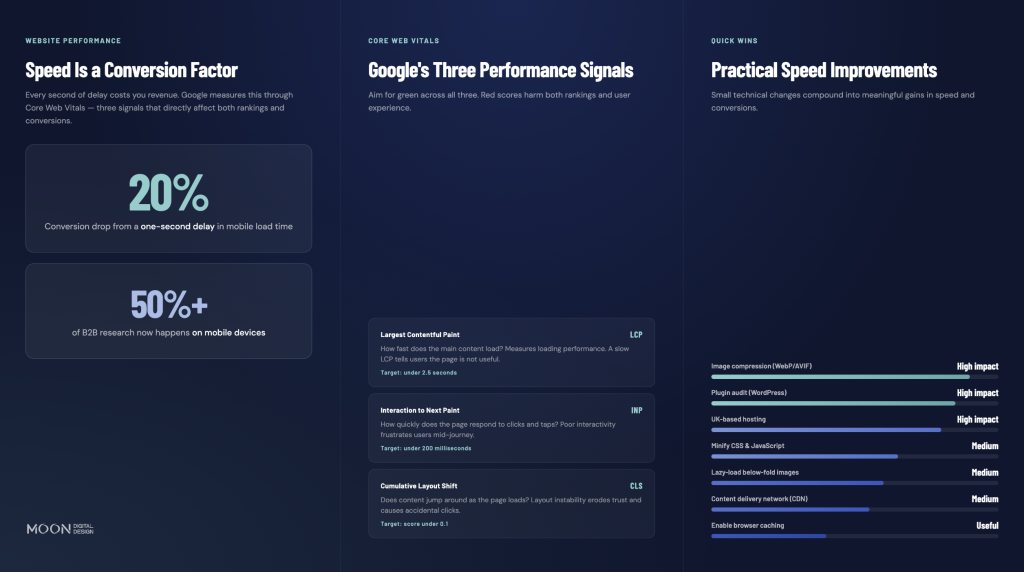
Core Web Vitals
Google’s Core Web Vitals measure three aspects of real-user experience: loading (Largest Contentful Paint), interactivity (Interaction to Next Paint), and visual stability (Cumulative Layout Shift). Aim for green scores across all three.
Practical Speed Improvements
Compress images using modern formats like WebP or AVIF, lazy-load images below the fold, minify CSS and JavaScript, enable browser caching, and use a content delivery network. For WordPress sites, auditing plugins is often the quickest win, each unnecessary plugin adds weight and attack surface.
Hosting Matters
A cheap shared host in a distant data centre will cap your performance no matter how well optimised the code is. For UK-facing B2B businesses, UK-based hosting with solid-state storage and a modern PHP or Node stack is a minimum expectation.
SEO Fundamentals for B2B Website Design
Design and SEO are not separate disciplines, they are two sides of the same coin. A site that is beautifully designed but invisible in search is a missed opportunity.
On-Page SEO Essentials
Every page needs a unique, descriptive title tag, a compelling meta description, a clear H1, a logical heading hierarchy, and well-written body content that answers the query behind the keyword. For a page targeting “website design Bury St Edmunds”, the title, H1, introductory paragraph, and a handful of supporting sections should all reflect that intent naturally.
Local SEO for Suffolk Businesses
If your buyers are local, or if you want to attract regional clients, local SEO is critical. Claim and optimise your Google Business Profile, build consistent NAP (name, address, phone) citations across directories, and publish location-relevant content. A dedicated page targeting “web design Bury St Edmunds” can rank alongside your homepage and capture search traffic you would otherwise miss.
Content Depth and E-E-A-T
Google rewards experience, expertise, authoritativeness, and trustworthiness. For B2B, this means publishing genuinely useful content written by identifiable experts, referencing sources, and demonstrating real-world experience through case studies and examples.
Content Strategy: The Engine Behind Long-Term Growth
A website without ongoing content will stagnate. Search visibility, authority, and lead generation all improve when you publish regularly.
Building a Topical Map
Start by mapping every topic your ideal customers care about. For a B2B website designer in Bury St Edmunds, this might include articles on WordPress versus bespoke builds, Core Web Vitals, local SEO, accessibility, GDPR, and conversion optimisation. Each article targets a specific query and internally links to the service page that could solve the underlying problem.
The Pillar-and-Cluster Approach
Group related articles around a central pillar page. A pillar page covers a broad topic comprehensively (for example, “B2B Website Design”), while cluster pages dive deep into specific sub-topics. Internal linking between them signals topical authority to search engines.
Repurposing Across Channels
A single long-form article can become a LinkedIn post, an email newsletter, a short video, a podcast talking point, and a sales enablement asset. B2B content compounds when it is reused thoughtfully.
Accessibility: Design That Works for Everyone
Accessibility is both a legal and an ethical consideration. Under the Equality Act 2010, UK businesses have a duty to make reasonable adjustments, and public sector bodies must meet specific accessibility standards.
WCAG 2.2 as a Baseline
Aim for compliance with Web Content Accessibility Guidelines (WCAG) 2.2 at Level AA. Key considerations include colour contrast, keyboard navigability, alt text on meaningful images, form labels, captions for video, and logical heading structure.
The Business Case for Accessibility
Accessible sites perform better in search, reach wider audiences, and are less likely to face legal challenges. Many accessibility improvements, better contrast, clearer copy, larger tap targets, also improve conversion for everyone.
Analytics and Measurement
If you cannot measure it, you cannot improve it. A modern B2B website should be instrumented from day one.
The Essential Analytics Stack
Google Analytics 4 for traffic and behaviour, Google Search Console for search performance, and a dedicated heat-mapping tool such as Hotjar or Microsoft Clarity for on-page behaviour. For more mature operations, add a CRM integration so you can track leads through to closed revenue.
Metrics That Matter in B2B
Avoid vanity metrics. Focus on qualified leads, cost per lead, conversion rate by source, average time to conversion, and revenue influenced by website content. Bounce rate and sessions are useful context, but they rarely drive decisions on their own.
Privacy and Consent
UK GDPR and PECR require consent for non-essential cookies. A compliant cookie banner, a clear privacy policy, and properly configured analytics are non-negotiable. A good website designer will set these up correctly by default.
Working with a Local Website Designer in Bury St Edmunds
Choosing the right partner is often the difference between a website that drives growth and one that becomes an ongoing source of frustration.
Why Local Matters
A local website designer in Bury St Edmunds understands the Suffolk business landscape, can meet in person when a project demands it, and is invested in long-term relationships rather than one-off transactions. Face-to-face strategy sessions, site visits for photography, and shared professional networks all add value that a faceless remote agency cannot match.
Questions to Ask Any Agency
Before you engage a web design agency, ask: Can you show examples of B2B work in similar industries? What is your approach to SEO and accessibility? Who will own the site after launch? What is your process for ongoing support and updates? How do you measure success? The answers will reveal whether the agency is a true partner or simply a vendor.
Budget Expectations
Quality B2B website design in Bury St Edmunds typically ranges from £3,000 for a small brochure site to £25,000+ for a complex platform with custom integrations. Be cautious of quotes at the very low end, they often reflect corner-cutting that shows up later in performance, security, or flexibility.
Maintenance, Security, and Ongoing Improvement
A website is a living asset, not a one-off project.
The Case for Ongoing Support
Platforms update, plugins need patching, content becomes stale, and new opportunities emerge in analytics every month. A support retainer ensures your site stays fast, secure, and aligned with changing business goals.
Security Essentials
SSL certificates, regular backups, plugin and core updates, strong authentication, and a web application firewall are all baseline expectations. For businesses handling client data, Cyber Essentials certification is increasingly a buyer requirement in itself.
Continuous Improvement Through Testing
The best-performing websites are never “finished”. A/B testing headlines, CTAs, form lengths, and page structures unlocks compounding improvements over time. Even small gains, a 5% lift in form completion, a 10% improvement in page speed, translate to meaningful revenue at scale.
Your Next Steps
A high-performing B2B website is not the product of a single decision, it is the result of dozens of small choices made well, across strategy, design, content, technology, and ongoing optimisation. The principles in this guide apply whether you are a start-up scaling across Suffolk or an established firm refreshing a tired site.
If you are considering a new website or a redesign, start by auditing what you have. Measure your current performance against Core Web Vitals, accessibility standards, and conversion benchmarks. Ask ten customers and ten employees what they find hard to do on your current site. That honest baseline will shape a much better brief than any agency template ever could.
From there, a clear roadmap emerges: define your audience, write your positioning, plan your content, design for clarity, build for speed, measure relentlessly, and improve continuously. Do those things well, and your website will stop being a cost centre and start being your hardest-working employee.
If you would like to talk through your project with an experienced team offering website design in Bury St Edmunds and across Suffolk, we would be pleased to help. A short discovery conversation is the best way to understand whether we are the right fit, and to leave you with useful next steps either way.
Ready to talk? Get in touch to arrange a no-obligation conversation about your B2B website project.